
Your compliance artifacts and SOC 2 reports were downloaded by procurement. Your pen test came back clean. Now their CISO wants a call.
This is where security edges out the competition. The report gets you to the conversation. The conversation determines whether the buyer's security team signs off or sends the deal into a quiet death spiral where "we'll get back to you" stretches into months of silence.
The companies that handle these calls well aren't the ones with the most mature programs. They're the ones who can articulate where they are, where they're going, and why they made the trade-offs they made. Honesty about gaps earns more trust than pretending they don't exist.
This guide covers the 15 questions that come up on virtually every enterprise vendor security call, with frameworks for answering them credibly — and the specific mistakes that make experienced CISOs stop taking notes and start writing their rejection.
Before the Call
Who Should Be on the Call
The person on your side of the call matters more than any document on your trust center. Buyers evaluate vendors on live calls because documents can be polished by anyone. The call reveals whether someone on your team has operational depth.
The right person is:
- Someone who understands the architecture well enough to answer follow-ups without hedging
- Someone who speaks the buyer's vocabulary, not just engineering terminology
- Someone who can pivot between executive-level explanation and technical deep-dive based on who's asking
That's usually a security lead, a senior engineer who's done these calls before, or a vCISO who knows your product. It's not your sales team with a cheat sheet.
The wrong person is:
- A CTO who hasn't practiced and will answer in implementation details ("we use PostgreSQL with RLS") instead of security properties ("tenant isolation is enforced at the database layer with row-level security, backed by application-layer middleware")
- Anyone who will say "I'll need to get back to you on that" more than once
- Anyone who gets defensive when a buyer probes a gap
Pre-Call Preparation
- Review what you've already sent. Pull up the questionnaire responses, the pen test attestation letter, and any documentation the buyer has seen. The person on the call should know exactly what's in every document — because the buyer does.
- Check for inconsistencies. If your questionnaire says "authorization enforced at middleware level" but your pen test found route-handler authorization gaps, the CISO will notice. Know the discrepancies before they do and have your response ready.
- Prepare your gap narrative. List your 3–5 known gaps and rehearse how you'll discuss each: what the gap is, why it exists (stage-appropriate prioritization, not negligence), what you're doing about it, and when. This is the highest-leverage preparation you can do.
- Know your audience. A CISO evaluating 50 vendors asks different questions than a security analyst doing a deep-dive. If you can, find out who'll be on the call and what their role is in the evaluation.
- Have evidence accessible. Architecture diagrams, data flow documentation, pen test report, SOC 2 scope section. Don't present them unprompted — but be ready to pull them up when a question goes deeper.
15 Questions
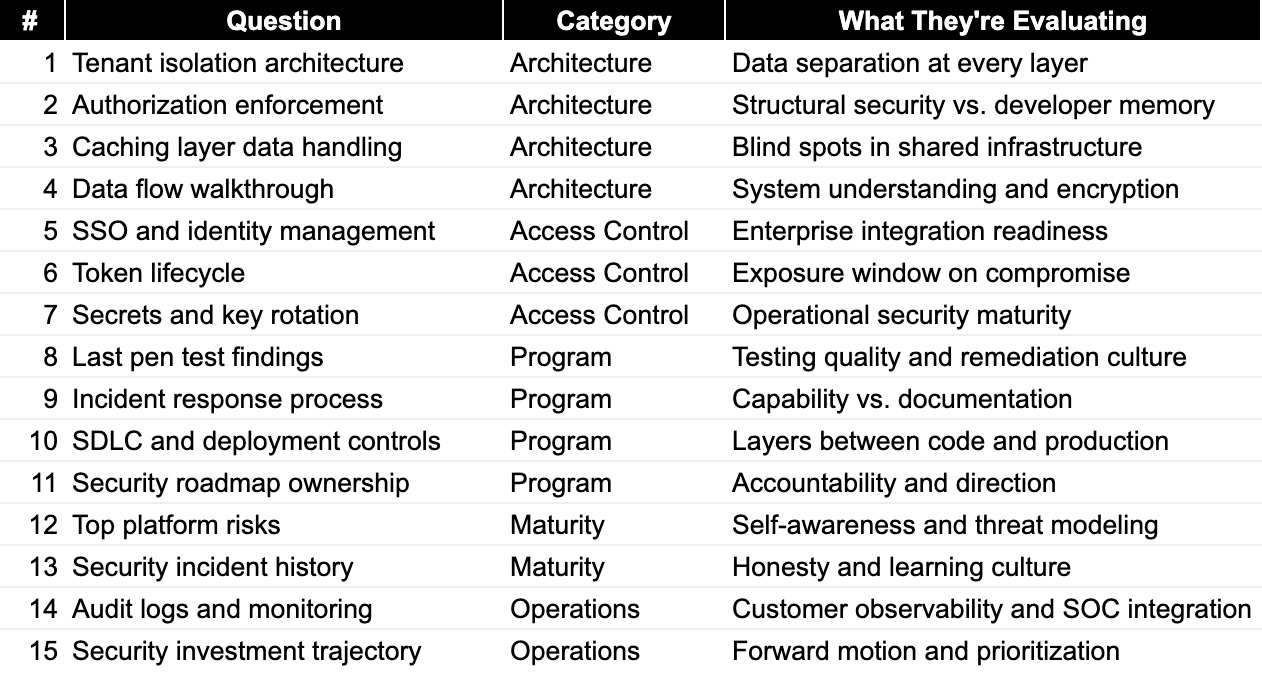
Each question includes what the buyer is really evaluating, a framework for a strong answer, and the specific mistakes that damage credibility.
ARCHITECTURE & ISOLATION
Q1. "Walk me through your tenant isolation architecture."
What they're really asking: Can a flaw in your application expose my data to another customer? They want to understand isolation at every shared layer — not just the application, but the database, cache, file storage, and message queues. This is the question that separates casual reviews from serious enterprise evaluation.
Framework for a strong answer: Start at the data layer and work outward. For each shared infrastructure component, explain:
- How tenant boundaries are enforced (application logic, database constraints, IAM policies)
- What happens if the application-layer check fails (is there a second line of defense?)
- Whether isolation has been tested adversarially (pen test, not just code review)
Example structure:
"Tenant isolation is enforced at multiple layers. At the database level, we use row-level security policies — every query is scoped to the tenant context, enforced by the database engine, not just application code. Our caching layer uses tenant-namespaced keys with separate logical databases per tenant in Redis. File storage is organized by tenant with IAM-level access controls, so even a compromised application credential for one tenant can't read another tenant's files. Our most recent pen test specifically targeted cross-tenant access at each of these boundaries."
What not to say:
- "We add a tenant ID to every query." (This is application-layer filtering only — one missed WHERE clause is a cross-tenant leak.)
- "Our ORM handles that." (Same problem. What happens when someone writes a raw query?)
- "We haven't had any issues." (Absence of detected problems isn't evidence of isolation.)
- Any answer that only addresses the application layer without mentioning database, cache, or storage.
Q2. "How is authorization enforced across your API?"
What they're really asking: If a developer forgets to add an authorization check to a new endpoint, does my data get exposed? They're evaluating whether your authorization model is structural (enforced by default) or aspirational (depends on every developer remembering every time).
Framework for a strong answer: Describe the enforcement mechanism, not just the policy. The critical distinction is: do new endpoints inherit authorization by default, or must developers add it? Then address granularity: what roles exist, how are permissions scoped, and how are API tokens restricted?
Example structure:
"Authorization is enforced at the middleware layer — every API request passes through our authorization service before reaching the handler. New endpoints require an explicit permission declaration; without one, the request is denied by default. We use role-based access control with [X] roles that map to specific permission sets. API tokens are scoped to named permissions, so a read-only integration token can't modify data even if the API endpoint supports writes. Our pen tests specifically target authorization bypass, including BOLA testing across tenant boundaries."
What not to say:
- "Each endpoint checks permissions." (This means route-handler authorization — the pattern most vulnerable to being forgotten on new code.)
- "We have RBAC." (Too vague. They'll follow up with "enforced where?")
- "We follow OWASP best practices." (Non-answer. Everyone claims this. What did you actually build?)
- "Our developers are careful about this." (Authorization that depends on human memory is the definition of what buyers are screening for.)
Q3. "What happens to customer data in your caching layer?"
What they're really asking: This is a probe for a blind spot. Most companies think about isolation at the database level but not at the cache, queue, or file storage layer. If you haven't thought about this, the CISO knows your isolation architecture has gaps you haven't considered.
Framework for a strong answer: Address the specific shared infrastructure they asked about (cache), but then proactively cover other shared layers. Explain: what's cached, how tenant boundaries are maintained in the cache, what the failure mode looks like, and whether it's been tested.
Example structure:
"We cache [specific data types] in Redis, namespaced by tenant ID with separate logical databases per tenant. Cache invalidation is tenant-scoped — clearing one tenant's cache doesn't affect others. The cache doesn't store raw sensitive data; cached objects are scoped to the authenticated tenant's context. Our pen test includes cache-layer isolation testing — we verify that requests authenticated as Tenant A can't access cache entries for Tenant B, even with manipulated cache keys."
What not to say:
- "We prefix keys with the tenant ID." (That's a naming convention, not an isolation control. What enforces it?)
- "We don't cache sensitive data." (Define sensitive. Session tokens? User metadata? Access permissions? The CISO's definition may differ from yours.)
- A blank stare. This question is designed to test whether you've thought beyond the database. If your answer is "I'm not sure how the cache handles multi-tenancy," that's the finding.
Q4. "Walk me through your data flow — from user input to storage."
What they're really asking: They want to identify every point where data could be exposed, intercepted, or leak to the wrong tenant. This also tests whether you've mapped your own system well enough to describe it — companies that can't diagram their data flow usually can't secure it either.
Framework for a strong answer: Walk through the path: client → network → application → processing → storage. At each step, address: encryption state, authentication/authorization check, tenant scoping, and logging. Keep it clear and sequential. Have an architecture diagram ready to share if the conversation goes deeper.
Example structure:
"User requests hit our API gateway over TLS 1.2+. The gateway authenticates the request, validates the API token scope, and routes it to the appropriate service. The service layer enforces authorization at middleware — tenant context is injected from the authenticated session, and all data operations are scoped to that tenant. Data is encrypted at rest using AES-256 with keys managed through [AWS KMS / your approach]. Application-layer encryption protects [specific sensitive fields]. Audit logs capture the request, the authenticated user, the action, and the timestamp."
What not to say:
- "It's a pretty standard architecture." (The buyer isn't checking whether your architecture is innovative. They're checking whether you understand your own system.)
- Skipping the encryption layer or assuming "HTTPS" covers it. (They want to know about data at rest, in transit between services, in the cache, in backups.)
- Omitting logging and monitoring from the data flow. (Data flow without observability is a red flag.)
AUTHENTICATION & ACCESS CONTROL
Q5. "How do you handle SSO and identity management?"
What they're really asking: Three things. First, can they manage their users' access through their identity provider (non-negotiable for enterprise)? Second, do you support their specific IDP? Third, is SSO a real feature or a bolt-on that breaks in edge cases?
Framework for a strong answer: Cover: which SSO standards you support (SAML 2.0, OIDC), whether SSO is available on all plans or gated, whether you support SCIM for automated provisioning/deprovisioning, and how you handle edge cases (what happens when SSO is required but a user tries to log in with a password?).
Example structure:
"We support SAML 2.0 and OIDC for SSO, available on [plan tier]. Organizations can enforce SSO-only authentication — password login is disabled when SSO is enabled. We support SCIM 2.0 for automated user provisioning and deprovisioning, so when someone leaves the buyer's organization and is removed from their IDP, they lose access to our product automatically. We've integrated with [Okta, Azure AD, Google Workspace, etc.] and support custom SAML configurations."
What not to say:
- "We support SSO." (Too vague. Which standards? Is it enforced or optional? Can admins require it?)
- "SSO is on our Enterprise plan." (Fine, but follow up with what it includes — SAML only? SCIM? JIT provisioning?)
- Nothing about deprovisioning. (The buyer's security team cares as much about removing access as granting it. If someone leaves their company, how fast does access go away?)
Q6. "What's your token lifecycle?"
What they're really asking: How long is the window of exposure if a token is compromised? They want to understand token expiration, refresh strategy, revocation capability, and what happens when a user's permissions change. Sloppy token management is a leading indicator of sloppy security thinking.
Framework for a strong answer: Cover the full lifecycle: issuance, expiration, refresh, revocation, and key rotation. Address the edge cases: what happens when a user's role changes? When they're deprovisioned? When a signing key is compromised?
Example structure:
"Access tokens are JWTs with a [15-minute / 1-hour] TTL. Refresh tokens are stored securely with a [X-day] lifetime and are rotated on each use — a refresh token can only be used once. When a user's permissions change, active sessions are invalidated and they must re-authenticate to receive updated claims. Token revocation is immediate on user deprovisioning. Signing keys are rotated on a [quarterly] schedule, and we have a documented procedure for emergency rotation if a key is compromised."
What not to say:
- "We use JWTs." (That's a format, not the lifecycle. Every follow-up question will expose this.)
- "Tokens expire after 24 hours." (24-hour tokens are generous. They'll ask what happens if a token is stolen — the answer is "the attacker has 24 hours." That's a long window.)
- "We haven't had a key compromise." (They're asking whether you have a plan, not whether you've needed one.)
- Any answer that doesn't address revocation. (Tokens you can't revoke are tokens an attacker can use until they expire.)
Q7. "How do you manage secrets and key rotation?"
What they're really asking: Are your secrets in environment variables (bad), in a secrets manager (good), or in version control history (very bad)? They're evaluating operational maturity: secrets management is a proxy for how seriously you take infrastructure security day-to-day, not just for audits.
Framework for a strong answer: Describe: where secrets are stored, who can access them, how they're audited, and how they're rotated. Cover production, development, and CI/CD separately — buyers know that companies often secure production but leave secrets exposed in pipelines or dev environments.
Example structure:
"Production secrets are stored in [AWS Secrets Manager / HashiCorp Vault / etc.] with audit logging on every access. Developer access to production secrets requires JIT approval through [tool/process] — no standing access. CI/CD secrets are injected at runtime through [approach], not stored in pipeline configuration. Database credentials rotate automatically on a [90-day] cycle. API keys for third-party services are scoped to minimum required permissions and rotated [annually / on a defined schedule]. We maintain a secrets inventory so we know what exists, where it's used, and when it was last rotated."
What not to say:
- "Environment variables." (How are they injected. Does this mean no audit trail, no rotation, and secrets visible to anyone with server access?)
- "We use a .env file." (Worse. Often committed to version control at some point. They know this.)
- Describing production but not CI/CD. (Supply chain security means the pipeline matters. If your CI runner has unscoped production credentials, that's a finding.)
- "We rotate when there's an incident." (No scheduled rotation means secrets accumulate. Old API keys that no one remembers creating are the ones that get leaked.)
SECURITY PROGRAM & PROCESS
Q8. "What did your last pen test find?"
What they're really asking: Two things. First, whether you get real pen tests (not scanner dumps). Second, and more importantly, how you responded to the findings. Your willingness to discuss findings openly — and show remediation — is a stronger trust signal than having zero findings.
Framework for a strong answer: Summarize scope, key findings, remediation status, and lessons learned. Don't recite the full report — highlight what was significant, what you fixed, and what it taught you about your architecture. Frame findings as evidence that testing works, not as problems to minimize.
Example structure:
"Our most recent pen test covered [scope — product API, auth flows, tenant isolation, cloud config]. The testers identified [number] findings — the most significant were [brief, honest description of 2-3 key findings and their severity]. We remediated all critical and high findings within [timeframe], including [specific architectural improvement, not just a patch]. Retesting confirmed the fixes. The engagement also led us to [systemic improvement — e.g., migrating authorization to middleware, adding RLS at the database layer]. The full attestation letter is on our trust center, and we can walk through the detailed findings under NDA if that would be helpful."
What not to say:
- "Nothing major." (Buyers don't believe a pen test that found nothing. It means the scope was too narrow or the testing was too shallow.)
- "I'd have to check with our security team." (If you're on this call, you should know what your pen test found. Not knowing signals the program isn't taken seriously at the leadership level.)
- Listing CVSS scores without context. (Three medium-severity IDOR findings that chain into cross-tenant data access are worse than one high-severity XSS on a marketing page. Context matters.)
- Describing findings without remediation. ("We found X" without "and here's what we did about it" raises more questions than it answers.)
Q9. "What's your incident response process?"
What they're really asking: If there's a breach that affects my data, will you know about it, will you respond competently, and will you tell me? They're evaluating whether your IR plan is a document someone wrote for the audit or a capability your team has actually practiced.
Framework for a strong answer: Cover: detection, escalation, containment, communication (especially customer notification), recovery, and post-incident learning. Mention whether the plan has been tested. If you've done a tabletop exercise, say so — it's one of the strongest signals of operational maturity.
Example structure:
"Our IR plan covers detection through [monitoring/alerting approach], with defined escalation paths based on severity. For a Severity 1 incident affecting customer data, our war room protocol activates within [timeframe], with a designated incident commander. Customer notification happens within [X hours] per our policy and applicable regulations. We ran our most recent tabletop exercise [when], simulating [scenario]. That exercise led us to [specific improvement — e.g., faster notification workflow, pre-drafted customer communications, runbook update]. Post-incident review is mandatory, and findings feed back into our controls and monitoring."
What not to say:
- "We have an incident response policy." (Policy is not capability. They'll ask when you last tested it, and "never" is the wrong answer.)
- "We'd figure it out." (Honest, but terrifying to a buyer whose data is at stake.)
- Omitting customer notification. (This is what they care most about. Everything else in your IR process is your problem. How fast they learn about it is theirs.)
- "We haven't had any incidents so we haven't needed to use it." (That's not reassuring — it means the process is untested.)
Q10. "Walk me through your SDLC — what catches a vulnerability before production?"
What they're really asking: Can a single developer push insecure code to production? They want to understand the layers between a code change and your customers: code review, automated scanning, testing, and deployment controls. The absence of layers is the finding.
Framework for a strong answer: Walk through the path from code commit to production deployment. At each stage, identify the security control: code review, SAST/DAST, dependency scanning, testing, and deployment gating. Be specific about what's automated versus manual.
Example structure:
"All code changes go through pull requests with required review from at least one other engineer. Our CI pipeline runs SAST [tool], dependency vulnerability scanning [tool], and secrets detection before a PR can be merged. We run [DAST/integration security tests] in staging. Branch protection prevents force-pushes to main. Deployment to production is automated through CI but gated on all checks passing — no manual deployments. Infrastructure changes go through the same PR and review process using infrastructure-as-code."
What not to say:
- "We do code review." (That's the minimum. They want to know what else exists. If code review is your only security control, a reviewer having a bad day is your last line of defense.)
- "We use [tool]." (Tool names without explaining what they catch and what happens when they find something is a non-answer.)
- "Developers can deploy hotfixes directly in emergencies." (Maybe necessary, but lead with the standard process. If emergency bypasses exist, describe the guardrails: who can authorize it, what review happens after.)
- Forgetting about dependencies. (Supply chain is a standard follow-up. If you don't scan dependencies, the buyer's next question will be about Log4j.)
Q11. "Who owns your security roadmap?"
What they're really asking: Is someone accountable for security direction, or does security happen reactively when deals demand it? This is a maturity test — companies with a security owner have a plan. Companies without one are assembling security by emergency.
Framework for a strong answer: Name the role (not necessarily the person), describe how priorities are set, and show that the roadmap connects to business reality (buyer expectations, pen test findings, threat model) rather than just compliance frameworks.
Example structure:
"Our [CISO / Head of Security / vCISO / CTO with security advisory support] owns the security roadmap. Priorities are informed by three inputs: pen test findings, buyer evaluation patterns — what's actually coming up in security reviews — and our threat model. The roadmap is reviewed quarterly. Right now our top priorities are [2-3 specific initiatives]. We explicitly decided to defer [something] because [rationale]. The board sees a security update [quarterly / as part of risk reporting]."
What not to say:
- "Everyone owns security." (No one owns security.)
- "Our CTO handles it." (If the CTO is also handling product, engineering management, and architecture, "handles security" means "responds to security emergencies." That's not ownership.)
- "We follow NIST CSF." (A framework is not a roadmap. It's a catalog of everything you could do. A roadmap is a sequenced plan of what you will do and when.)
- Avoiding deprioritization. (Saying "everything is a priority" tells the buyer no one is making hard decisions. Naming what you chose NOT to do, and why, is a stronger signal of maturity than a long list of initiatives.)
RISK & MATURITY
Q12. "What are the top five risks to your platform?"
What they're really asking: Have you done threat modeling, or is security an afterthought? This question tests self-awareness. A company that can name its risks and explain its mitigation strategy earns trust. A company that says "we don't have risks" earns a rejection.
Framework for a strong answer: Name 3–5 specific, honest risks relevant to your architecture and business. For each, explain: what the risk is, what you've done to mitigate it, and what residual risk remains. Demonstrate that you've thought about this proactively, not just when asked.
Example structure:
"Our top risks are: (1) Cross-tenant data exposure through authorization bypass — we mitigate with middleware enforcement and pen test focus on BOLA/IDOR, but multi-tenant SaaS inherently carries this risk. (2) Supply chain compromise through a dependency or CI/CD pipeline — we scan dependencies and gate deployments, but the attack surface is broad. (3) Credential compromise for a privileged team member — we use JIT access and MFA, but insider risk is never fully eliminated. (4) [Something specific to your architecture]. We prioritize mitigation for these based on exploitability and business impact."
What not to say:
- "We don't have major risks." (Every platform has risks. Claiming otherwise means you haven't looked.)
- "Compliance is our biggest risk." (Compliance risk is a business risk, not a platform risk. The CISO asking this wants to hear about technical threats.)
- Listing generic risks from a textbook. ("Phishing," "ransomware," "data breach" without specificity to your platform tells the buyer you copied the list.)
- Being unable to name any. (This is the single strongest signal that security hasn't been thought through at a leadership level.)
Q13. "Have you had any security incidents?"
What they're really asking: Not whether you've had incidents (everyone has), but how you handled them and what you learned. They're also checking whether you'll be honest. Saying "never" strains credibility — and if they later discover an unreported incident, the deal is dead and the relationship is over.
Framework for a strong answer: If you've had incidents: describe them at an appropriate level (scope, impact, response, outcome, what you changed). If you genuinely haven't had a reportable incident: say so, but pivot to how you'd handle one and what near-misses or exercises have taught you.
Example structure (with incident history):
"We had [brief description] in [year]. We detected it through [monitoring/reporting], contained it within [timeframe], and notified affected customers within [timeframe]. The root cause was [honest description]. Post-incident, we implemented [specific changes — new controls, monitoring, architecture change]. That incident directly led to [improvement that's now a strength]."
Example structure (no incidents):
"We haven't had a reportable security incident. But that doesn't mean we're complacent — our pen tests have identified vulnerabilities that could have led to incidents if exploited, and our tabletop exercises have revealed gaps in our response process that we've since fixed. Most recently, [specific example of a near-miss or exercise finding and what changed]."
What not to say:
- "No, never." (with no follow-up). (Strains credibility and misses an opportunity to demonstrate maturity. Even "we've never had a reportable incident, but here's what we've learned from exercises" is stronger.)
- Minimizing a known incident. (If they've done their research and find a public disclosure that contradicts your answer, the conversation is over.)
- Deflecting to tooling. ("We have endpoint protection and SIEM" doesn't answer the question.)
OPERATIONAL MATURITY
Q14. "How can we monitor activity in our account? Where are your audit logs?"
What they're really asking: Their SOC needs to see what's happening in your product. If their security team can't audit who did what and when inside your platform, they can't meet their own compliance and monitoring obligations. No audit logs means your product creates a blind spot in their security program.
Framework for a strong answer: Cover: what's logged (user actions, permission changes, data access, admin operations), how customers access logs (UI, API, export), retention period, and whether you support SIEM integration (log streaming).
Example structure:
"We provide comprehensive audit logging covering user authentication events, permission changes, data access, API calls, and admin operations. Each log entry includes timestamp, user ID, IP address, action performed, and affected resource. Customers can access logs through the product UI with filtering and search, export as CSV or JSON, and [if applicable] stream logs to their SIEM via webhook or S3 integration. We retain audit logs for [retention period]. Our documentation covers the full event schema so your team can build alerting rules on our log data."
What not to say:
- "We have logging." (Application error logging is not audit logging. The buyer wants user-action audit trails, not your debug logs.)
- "Logs are available on request." (If the buyer's SOC has to email your support team every time they need to audit activity, that's a deal-breaker for companies with active security monitoring.)
- Nothing about retention. (If logs disappear after 30 days, the buyer can't meet their own audit requirements.)
- Omitting SIEM integration if you support it. (This is a differentiator. If you have it, lead with it.)
Q15. "What does your security investment look like over the next 12 months?"
What they're really asking: Are you going to be more secure a year from now, or is this the high-water mark? Sophisticated buyers evaluate trajectory. A company with honest gaps and a funded plan to close them is a better bet than one that checks boxes today with no investment direction.
Framework for a strong answer: Share 2–3 concrete initiatives with rough timelines. Connect each to a specific driver (pen test finding, buyer feedback pattern, architecture evolution, threat model). Include at least one explicit deprioritization — what you've decided NOT to invest in yet and why. This signals strategic thinking, not just reactive spending.
Example structure:
"Our security priorities for the next 12 months are: (1) Migrating authorization enforcement from route handlers to a centralized policy engine — currently 60% complete, targeting Q3. This is driven by our pen test findings and the pattern of authorization questions we see in security reviews. (2) Implementing automated secrets rotation for all production credentials by Q4. (3) Standing up real-time security monitoring with detection rules tuned to our threat model — we're evaluating approaches now. We've explicitly decided to defer [example — e.g., FedRAMP readiness] because our current buyer base doesn't require it, and the investment is better spent on [the priorities above]."
What not to say:
- "We're focused on maintaining our SOC 2." (Maintenance is not investment. Buyers want to see forward motion.)
- "We have a lot of initiatives planned." (Vague. Name them. If you can't, the roadmap doesn't exist.)
- "We're doing everything." (No you're not. And claiming to tells the buyer no one is making prioritization decisions.)
- Listing 15 priorities. (If everything is a priority, nothing is. Three initiatives with clear rationale beat a long list that signals no hard choices have been made.)
Handling the Hard Moments
When You Don't Know the Answer
It will happen. A buyer asks about something you haven't considered. The wrong move is guessing. The right move:
"That's a good question and I want to give you an accurate answer rather than speculating. Let me confirm [specific detail] and get back to you by [specific day]. Here's what I can tell you now about our approach to [the broader topic]..."
One "let me get back to you" is fine. Three means you weren't prepared. Five means the buyer has lost confidence.
When They Find a Gap
Buyers expect gaps. What they're evaluating is your response.
The framework:
- Acknowledge the gap honestly — don't deflect or minimize
- Explain the context — why this gap exists (stage-appropriate prioritization)
- Show the plan — what's being done and when
- Demonstrate awareness — show you understand why this matters to them specifically
Example:
"You're right — authorization is currently enforced at the route-handler level, not middleware. We've prioritized this migration and we're about 60% through it. We mitigate the interim risk through mandatory code review for every PR touching authorization and quarterly pen testing that specifically targets authorization bypass. We expect full middleware enforcement by Q3."
Compare that to: "We follow OWASP best practices for authorization." The first answer shows self-awareness, a plan, and interim mitigation. The second answer confirms the buyer's suspicion that you haven't thought about it.
When They Push on Something You've Deprioritized
Not every gap needs to be fixed right now. Defending your prioritization is a strength, not a weakness.
"We've evaluated that capability and made a deliberate decision to defer it. At our current scale and architecture, the risk it addresses is lower priority than [what you're investing in instead]. Here's why: <some specific rationale>. If your requirements make this a priority for this evaluation, we should discuss the specifics — we want to understand your environment."
When Artifacts Contradict Each Other
If a buyer notices an inconsistency between your questionnaire, your pen test report, and what you say on the call — and some will — don't pretend it doesn't exist.
"Good catch. Our questionnaire answer reflects [the current state / the target state], and the pen test finding reflects [what was true at time of testing]. Since the pen test, we've [specific remediation]. I should update our questionnaire response to reflect the current state — thanks for flagging that."
Transparency on a contradiction earns more trust than a smooth explanation of why the contradiction doesn't matter.
After the Call
Immediate Follow-Up
- Send any promised follow-ups. "I'll get back to you" with no follow-through is the most common way to lose a deal after a good call.
- Send a brief summary email. Recap key topics discussed, reference evidence shared, and link to your trust center. Make it easy for the security analyst to write their internal evaluation by giving them the talking points.
- Note the questions you weren't prepared for. They'll come up again with the next buyer.
Building the Muscle
Each buyer call should make the next one easier:
- Maintain a question bank. Track every question you get across all buyer calls. After 10 calls, you'll have heard 80% of what any buyer will ask. After 20, you'll anticipate questions before they're asked.
- Update your artifacts. If a call revealed a gap between your documentation and reality, fix the documentation. If a question exposed a topic your security whitepaper doesn't cover, add it.
- Debrief with your team. What went well? What caught you off guard? What should the next caller know?
- Rehearse. The difference between a fumbled answer and a confident one is usually practice, not knowledge. Run through the 15 questions with a colleague playing the skeptical CISO.
The goal is that buyer calls get shorter over time because the CISO runs out of questions faster. That's the signal that your security program and your ability to communicate it have matured together.
Quick Reference: Question Categories

.jpg)